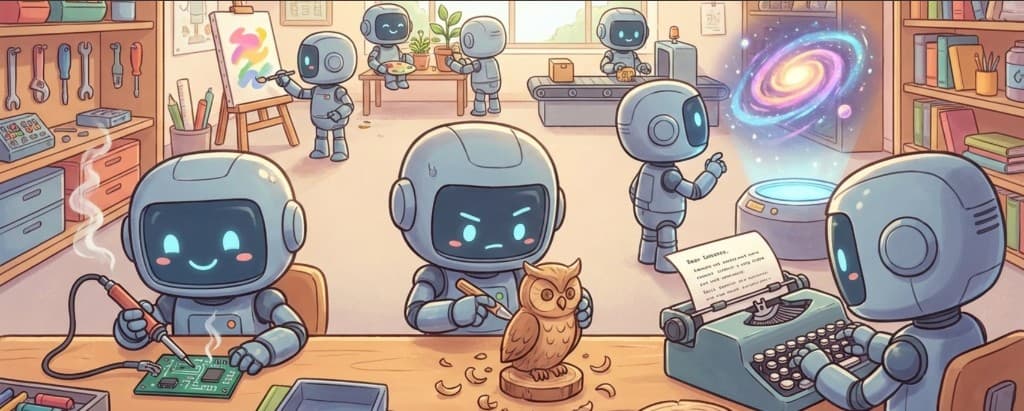
Alton Brown says the only unitasker in his kitchen is a fire extinguisher. Adam Savage wrote a whole book called "Every Tool's a Hammer."
At first glance, they seem to be making opposite points. Brown is warning against over-specialization (don't buy an avocado pitter when your chef's knife works fine). Savage is warning against over-planning (don't wait for the perfect tool, just use what's handy).
But they're actually circling the same idea: Tools are not neutral, and all have to earn their place.
The fire extinguisher passes the test because nothing else puts out a kitchen fire. The avocado pitter fails because your knife already does that job. The question isn't "specialized or general?" The question is: does this tool do something valuable that nothing else in my kit can do?
I've been thinking about this a lot lately, because everyone I know is building AI agents. And I'm unsure if these tools are long-term sustainable.
The Optimization Trap
The promise of the all-in-one agent is seductive: one genius that does everything. Research, writing, scheduling, coding, analysis. Why juggle ten tools when you could have one?
The reality: people are spending more time tweaking their setup than doing actual work.
I've seen this pattern before. People starting businesses who want to perfect the website, the business card, the logo before they talk to a single customer. That's backwards. Daedalus started by accident. Three people asked us for help and we said, "Oh crap, we should probably get an LLC going!"
The all-in-one agent is the same trap. Just one more tweak, just one more feature, then I'll be ready to start doing. It's a dopamine loop disguised as productivity.
I've been hiring people (meat agents, if you will) for 10 years. Generalists are great until they give you half-assed Canva files or make mistakes on a contract. That's why we have lawyers and accountants and designers. We pull them out when needed.
The reason we didn't always use specialists wasn't context switching. It was cost. Now, with AI, the cost is collapsing.
And honestly? The context switching is a feature, not a bug. Switching tools forces you to switch frames. You think differently when you open a legal document than when you open a design file. That's good.
So what does earn its place?
Not the avocado pitter. Not the shampoo-conditioner-toothpaste-body-wash combo either. Both fail, just in opposite directions.
A bread knife earns its place. It's a knife, optimized. Great at bread, but it also handles tomatoes and other delicate items that need a serrated edge. It does one thing exceptionally well, and that thing is useful often enough.
Things I've thrown out: sous vide machines, food processor combos, devices that promised to do everything. The only unitasker that survived my kitchen? The ice cream maker. Because when you need to make ice cream, nothing else will do.
Two ways to fail the test: too narrow to matter, or too broad to excel.
The Workshop in Action
I'm writing this article with Claude Cowork. It can do almost anything. But I've narrowed it down to: research, voice, outline, writing, editing. That's it.
That constraint gave me structure. I can now, for the first time ever, publish one article a week.
I've watched smart people (myself included, for a while) wrestle with all-in-one agents. Tweaking prompts, debugging workflows, chasing the promise.
My setup is different. Archie for organization, reminders, life admin. Claude Cowork for researching and writing, another for minor legal work. A few smaller agents for other things. Each one does one thing well.
I've been more productive in the last three weeks than in the last five years. The only time I felt this productive was leading an award-winning team at my last consulting firm. Back then, I had a team of specialists. Now I have a workshop of agents.
Intelligence scales through orchestration, not scope.
Ten narrow, well-defined agents will outperform one bloated agent that tries to do everything. Adam Savage put it this way: "After you get their buy-in on the larger vision, you need to strictly define their roles in the fulfillment of that vision, and then you need to set them free to do their thing."
That's the model. Not one genius. A workshop full of tools, each one earning its place.
Don't build a genius. Build a workshop.